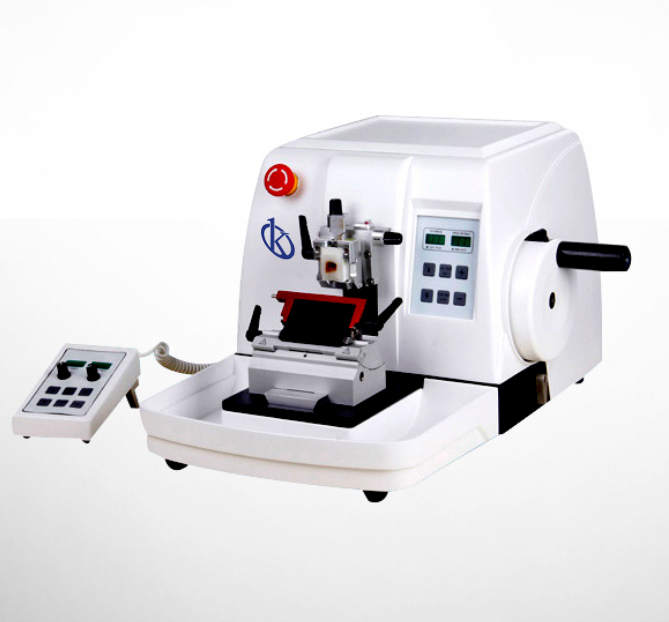
In the specialized field of histology, choosing the right automated microtome is crucial for precision and efficiency. Today, we compare two popular models: the Automated Microtome YR415-1 by Kalstein and the Automated Rotary Microtome RM2245 by Leica Microsystems. Both devices are designed for high performance and accuracy, yet they cater to different needs and preferences in laboratory settings.
The Automated Microtome YR415-1 by Kalstein offers cutting-edge features suited for an array of histological applications. With advanced automation, it streamlines the sectioning process, enhancing user experience and productivity. Meanwhile, the Automated Rotary Microtome RM2245 from Leica Microsystems is renowned for its robust design, offering reliable and precise slicing capabilities suitable for laboratory professionals who value traditional rotary systems with modern enhancements.
| Feature | Kalstein YR415-1 | Leica RM2245 |
|---|---|---|
| Automation | Fully automated | Semi-automated |
| Cutting Motor | High precision stepper motor | Manual with optional motorized module |
| Section Thickness | 0.25 to 100 microns | 0.5 to 60 microns |
| Sample Retraction | Variable settings | Manual |
| Knife Holder | Universal, adjustable for various knives | Compatible with standard disposable blades |
How They Work
The Kalstein Automated Microtome YR415-1 employs a state-of-the-art stepper motor system that ensures precise cutting by automating the sectioning process. Its intuitive interface allows users to adjust settings with ease, minimizing manual intervention and allowing focus on sample quality.
In contrast, the Leica RM2245 combines traditional rotary design with modern enhancements, offering semi-automated features. Users manually operate the rotary handle while benefiting from the precision enhancements available in this model, such as section thickness settings.
What They Are Used For
Both microtomes are utilized in histological laboratories for slicing tissue samples into thin sections for microscopic examination. The Kalstein YR415-1 is ideal for labs prioritizing automation and efficiency, while the Leica RM2245 appeals to those who prefer manual control with additional precision technologies.
Types
Automated microtomes generally fall into fully automatic and semi-automatic categories. The Kalstein YR415-1 is a fully automatic model, providing complete mechanization of the cutting process. Conversely, the Leica RM2245 is semi-automatic, offering a blend of manual control and automatic capabilities.
Market Price
The market price for automated microtomes varies significantly based on features and brand. The Kalstein YR415-1 offers value with its comprehensive automation and is competitively priced. Meanwhile, the Leica RM2245 is priced higher, reflecting its established brand and quality, yet it might require additional investment for motorized upgrades.
Frequently Asked Questions
What section thickness range is available with Kalstein YR415-1?
The Kalstein YR415-1 offers a wide range from 0.25 to 100 microns, accommodating various tissue types and research needs.
Does the Leica RM2245 provide automated sample retraction?
No, sample retraction on the Leica RM2245 is manual, maintaining user control over the process.
Is training required to operate these microtomes?
Both models are user-friendly; however, initial training is recommended to fully exploit the advanced features they offer.
Advantages and Disadvantages
Kalstein YR415-1 offers an impressive automation level, reducing human error and increasing throughput. Its stepper motor system allows for unmatched precision and customization. However, for labs with traditional preferences, the learning curve could be a minor drawback.
On the other hand, the Leica RM2245 provides reliability with its robust design, combining manual control with precision settings. Yet, the lack of full automation might slow down processes in fast-paced labs.
Use in the Field
In practical laboratory settings, the Kalstein YR415-1 shines in environments requiring high-efficiency workflows, such as large research facilities where sample processing speed and consistency are paramount. Its automation minimizes manual handling, increasing productivity.
The Leica RM2245 serves well in settings valuing precision and control over speed, such as specialized research labs focusing on detailed sample analysis.
Recommendations
To maximize the efficacy of your microtome, ensure regular maintenance and calibration. For the Kalstein YR415-1, familiarize yourself with the automation settings to fully leverage its capabilities. Consider arranging scheduled servicing for both models to maintain optimal performance. For detailed queries, contact the manufacturer or use Kalstein’s platform to explore more.
If you're interested in a fusion of innovation and quality, you've come to the right place. At Kalstein, we offer you the luxury of exploring our exclusive catalog of laboratory equipment. We manufacture each device with a level of excellence. Our intuitive and agile online shopping channels are designed for your convenience, ensuring the friendliest prices. Don't hesitate any longer, we bring science to life, it's time to become part of our community. https://kalstein.iq/product/automated-microtome-yr415-1/.