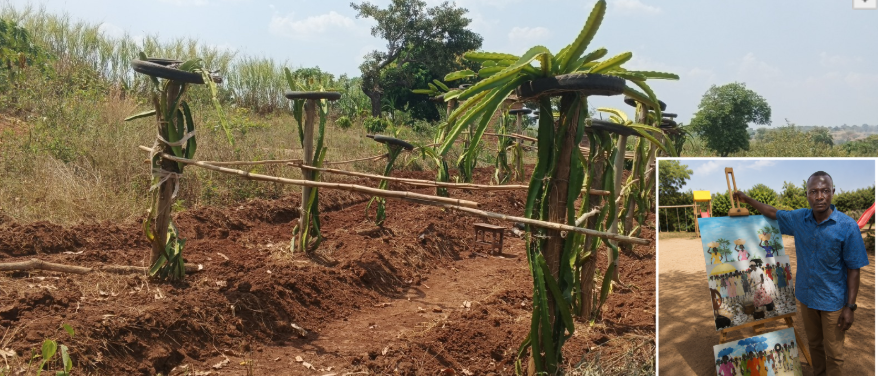
Edward Nyadru has spent more than 16 years on the front lines of humanitarian response. Today, he is also cultivating his own land with fruits that can withstand droughts and floods, proving that another path is possible.
Image credit: Edward Nyadru (AI-generated content)
Before the NGOs, before the field projects, there was the soil.
Edward Nyadru Augustine Abdalla, a multidisciplinary professional from South Sudan, grew up in a farming family.
“The farm was my first classroom.”
This childhood foundation eventually shaped a professional conviction decades later: sustainable agriculture is, in itself, a humanitarian act.
With more than 16 years of field experience working for organizations such as the International Committee of the Red Cross (ICRC), Oxfam, HelpAge International, and the Norwegian Refugee Council (NRC)—where he has worked for the past five years—Nyadru has witnessed firsthand what hunger truly means. He trains farmers, distributes seeds and tools, and supports communities in cultivating vegetables and staple crops such as maize and sorghum.
Yet every year, floods destroy harvests. Every season, funding becomes scarcer. And every day, millions of people survive on a single meal.
7 to 8 Million People Without Food Security
South Sudan is consistently ranked among the countries most vulnerable to food insecurity in the world. According to Nyadru, the roots of the crisis are twofold: chronic political instability and accelerating climate change.
“When there is no peace, nothing can be built in a country.”
Since 2021, severe flooding has affected several states each year, particularly Unity, Jonglei, and Upper Nile. Arable land continues to shrink, communities are displaced, and maize—the country’s primary crop—cannot survive prolonged waterlogging.
At the same time, international funding is declining. The World Food Programme (WFP), a cornerstone of emergency assistance, has seen its resources diminish and its workforce reduced. In 2026, between seven and eight million people are facing acute hunger.
The political situation further compounds the crisis. The 2018 peace agreement remains fragile, sporadic clashes continue to displace entire populations, and roads—often impassable during the rainy season—are lined with illegal checkpoints that dramatically increase transportation costs for food supplies.
As a result, nearly all food products consumed in the country—including tomatoes, cabbage, onions, and maize flour—are imported from neighboring Uganda.
From Research to Reality on the Ground
In December 2024, Nyadru earned a Master’s degree in Project Management from the University of Salford in Manchester. He completed the program entirely online while balancing professional responsibilities and family life.
His final research project focused on agribusiness—a theme he transformed into concrete action at the same time by establishing his own farm.
“What I had written on paper, I wanted to bring into reality.”
His choice of crops was deliberate. Nyadru selected highly nutritious species capable of withstanding climate-related challenges, including dragon fruit, pineapple, banana, and apple.
These crops can survive prolonged droughts, require relatively little water, and provide long-term yields. Fruit trees also contribute to soil regeneration and help improve local environmental conditions.
“Trees are very effective at attracting rainfall.”
A Farm Designed as a Community Seed Bank
In the long term, Nyadru does not intend for his farm to remain a private venture.
He envisions it as a future community seed bank—a local source of planting materials for farmers across the region and a model that can be replicated elsewhere. The farm is already providing employment opportunities for members of his family, and he hopes it will create many more jobs as it expands.
In a country where the December 2026 elections generate both hope and uncertainty, and where humanitarian workers face significant risks—a World Food Programme employee was killed while on duty in Upper Nile State in early 2026—Nyadru’s initiative represents a long-term response to a deeply structural crisis.
“Sustainable agribusiness is the only path that can solve these challenges once and for all, provided the model is managed properly.”
Source: Kalstein Media